1960s Fashion: Mod, Mini, and the Hippie Counterculture
No decade in the 20th century reorganized fashion as completely as the 1960s. Power moved from couture houses in Paris to teenagers in Carnaby Street; hemlines climbed faster than at any point in history; and the very idea of dressing like one's parents collapsed in roughly thirty-six months.
The cultural backdrop
The 1960s broke neatly into two halves. The first half (1960–1965) carried the polish of the late 1950s into the new decade — Jackie Kennedy in the White House, the Twist, the Beatles' first suits — but with a clear youthward shift. The second half (1966–1969) detonated. Civil rights legislation, the assassination of John F. Kennedy in 1963, the escalation of the Vietnam War, the contraceptive pill (FDA-approved in 1960), the moon landing in 1969, and the rise of an entire post-war generation of teenagers turned fashion into a daily political statement.
For the first time, "youth" was not just a market — it was the dominant cultural force, and the rest of fashion followed it. The Beatles' arrival in America in February 1964 marked the moment British style overtook Paris; Time magazine declared London the "Swinging City" in April 1966. By 1968, fashion had splintered into a dozen overlapping subcultures and never really reassembled.
Women's fashion: three distinct phases
Phase 1: the Jackie years (1960–1963)
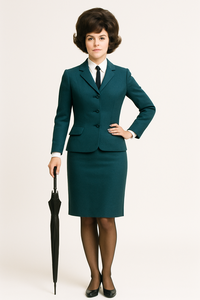
Early-1960s women's fashion is essentially late-1950s fashion with a touch more youth and a pillbox hat. Jackie Kennedy was its avatar: knee-length sheath dresses by Oleg Cassini, three-quarter-sleeve coats with oversized buttons, the Hermès Kelly bag, white cotton gloves, the Halston pillbox hat. The shape is still polished and adult; the color palette has lightened to creams, pastels, and soft brights.
Phase 2: the Mod years (1964–1967)
In 1964, Mary Quant — the British designer running a Chelsea boutique called Bazaar — pushed hemlines five inches above the knee. André Courrèges did the same in Paris. Within months, the mini skirt was the defining garment of the decade. Skirts were paired with simple A-line shift dresses, often without a defined waist; geometric monochrome prints (Mary Quant's daisies, Bridget Riley-style op art); knee-high boots in white or black PVC; and short, geometric haircuts cut by Vidal Sassoon (the iconic "five-point cut" debuted in 1964).
Couturiers responded with their own futuristic visions. Pierre Cardin's "Cosmocorps" silhouette featured vinyl, chrome zippers, and helmet-like hats; Paco Rabanne's chain-mail dresses (1966) used aluminum and plastic instead of fabric. The "space age" look — white go-go boots, vinyl, geometric shapes, helmet hats — became a global shorthand for modernity.
Phase 3: the hippie years (1967–1969)
The 1967 "Summer of Love" reversed the mod silhouette almost overnight. Hemlines dropped — sometimes to the floor — but skirts also continued in mini form, creating the new "midi/maxi/mini" three-tier coexistence that has never gone away. Bell-bottom jeans, peasant blouses, fringed leather vests, paisley prints, embroidered tunics, kaftans, headbands, beads, and flowers replaced PVC and chrome. Yves Saint Laurent's 1967 "Africa Collection" and 1968 "Saharienne" safari jackets brought hippie elements into couture.
Men's fashion: from Beatles suits to long hair
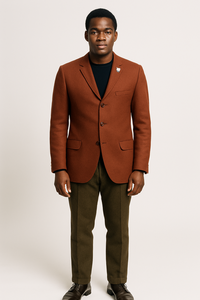
Early-1960s menswear was still dominated by the slim, single-breasted Italian and Ivy League suits of the late 1950s. The Beatles wore narrow-lapelled, collarless Pierre Cardin-inspired suits with Cuban-heeled "Beatle boots" — a silhouette that defined Mod menswear in Britain. Carnaby Street boutiques like John Stephen's stocked floral shirts, hipster trousers, and corduroy three-piece suits in plum, mustard, and bottle green.
By 1968 men's hair had grown long, sideburns had grown thick, mustaches were back, and the hippie's wardrobe — bell-bottom jeans, embroidered shirts, Nehru jackets (popularized briefly after Mia Farrow gave one to the Beatles), tie-dye T-shirts, turquoise jewelry — was visible on every campus. The military-surplus parka, jean jacket, and field coat all entered general menswear from anti-war protest culture.
Hair, makeup, and accessories
Vidal Sassoon's geometric cuts (the bob, the five-point cut, the asymmetric crop) dominated the mid-decade; the bouffant beehive — actually peaking in the early 1960s — looms in popular memory but was already old-fashioned by 1965. By 1968, long, ironed-flat center-parted hair was the universal hippie standard.
Makeup was the decade's great theatre. Mod girls drew on pale matte foundation, almost no blush, exaggerated upper-lash eyeliner with painted-on lower lashes (the "Twiggy eye"), and pale, almost beige lipstick. Hippie makeup minimized everything except the eyes — kohl, glitter, and flower decals on the cheekbones.
Key accessories: white knee-high go-go boots; Mary Jane heels; pillbox and helmet hats; oversized round sunglasses; chain belts; large hoop earrings; peace-sign jewelry; PVC handbags. Tights, made wearable by the rise of the mini, became a fashion category in their own right with Mary Quant's signature daisy-printed colored tights.
Icons of the decade
- Jackie Kennedy — Defined the early-decade adult silhouette and the pillbox hat.
- Twiggy — Lesley Hornby. The 16-year-old British model whose 1966 "Face of the Year" cover made the boyish, large-eyed look the dominant beauty standard.
- Mary Quant — Invented the mini skirt as a commercial product and put London at the center of fashion.
- The Beatles — Whose changing wardrobe (matching collarless suits, then Sgt. Pepper's military uniforms, then Indian-influenced flowing shirts) charted the decade's trajectory.
- Edie Sedgwick — Andy Warhol's Factory star: black tights, striped shells, oversized chandelier earrings, kohl-rimmed eyes.
- Yves Saint Laurent — Whose 1966 Le Smoking tuxedo for women, 1965 Mondrian dress, and 1967 safari jackets redefined what couture could be.
- Veruschka, Penelope Tree, Jean Shrimpton — The "fashion model as celebrity" started here.
Gallery



How to recreate the 1960s look today
- Jackie/early-decade: a knee-length sheath dress in pastel boucle wool, three-quarter sleeves, a small structured handbag, low court shoes, a pillbox hat, and large round pearl earrings.
- Mod: a sleeveless A-line shift dress in monochrome geometry or op-art print, knee-high white boots, opaque colored tights, a sharp Vidal Sassoon-style bob, and dramatic upper-lash eyeliner.
- Hippie: bell-bottom jeans or a maxi peasant skirt, a flowy embroidered or paisley blouse, a fringed suede vest, a leather headband, lots of beaded jewelry, long center-parted hair.
- Mod menswear: a slim three-button suit with narrow lapels in a non-traditional color, a polo-collar shirt, Chelsea or Beatle boots, a longer mod fringe haircut.
Common identification mistakes
- vs. late 1950s: 1958–1962 is one continuous look; the line gets drawn at hemline. Above the knee = 1960s. At or below the knee with petticoats = 1950s.
- vs. 1970s: the late-1960s hippie and early-1970s bohemian look are indistinguishable. By 1972 platform shoes, polyester, and louder prints push it firmly into the 1970s.
Upload a photo and the AI will tell you which decade it matches.