1920s Fashion: The Flapper, the Bob, and the Jazz Age
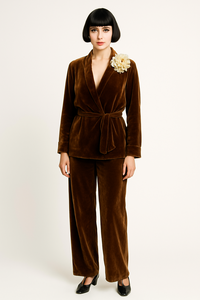
After four years of war and a global flu pandemic, the 1920s arrived with a thirst for noise, motion, and modernity. Fashion responded by abandoning almost everything the previous century had insisted on: corsets, ankle-length skirts, long hair, and the idea that respectable women didn't show their knees.
The cultural backdrop
To understand 1920s fashion you have to understand the decade's strange, electric optimism. The First World War had ended in November 1918. The 1918 influenza pandemic had killed tens of millions more. By 1920 — the year American women won the vote with the 19th Amendment, and the year Prohibition began — there was a generation of young people who had inherited an exhausted world and decided to dance their way through it. Jazz, which had moved up from New Orleans during the war, became the soundtrack. Hollywood produced its first true stars. Cars became affordable. Department stores filled with ready-to-wear clothing aimed at working women, not just the wealthy.
All of this shows up in the clothes. The 1920s silhouette is fundamentally kinetic: it was designed to move. You couldn't dance the Charleston in a corset and a hobble skirt, so designers gave women dresses cut as straight tubes, with fringe and beading that swung with every step. The body the period idealized was boyish — small bust, narrow hips, no defined waist — which meant for the first time in centuries the fashionable shape was achievable without painful undergarments.
Women's fashion: the flapper silhouette
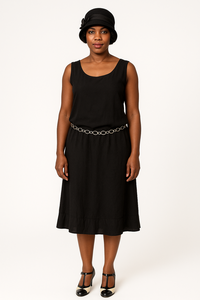
The defining garment of the decade is the flapper dress: a straight, sleeveless tube that drops from the shoulders to a low waistline somewhere around the hips, then flares slightly to a hem at or just below the knee. Early in the decade hemlines hovered mid-calf; by 1925 they had risen to the knee, the highest point women's daywear had ever reached. Construction was light — silk crepe, georgette, chiffon — and the surface was where the work happened: glass-bead embroidery, sequins, fringe, lamé, and Art Deco geometry borrowed from the architecture and graphic design of the period.
Daywear
- Drop-waist day dresses in jersey, wool crepe, or printed cotton
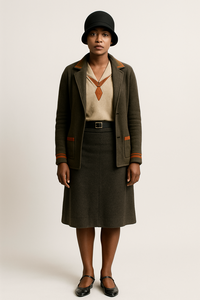
- Coco Chanel's revolutionary tweed cardigan suits, which made a luxury house out of borrowing menswear's ease
- Pleated skirts paired with sweater-blouses
- Long ropes of pearls or beads, often knotted
Evening wear
- Beaded and fringed flapper dresses for the dance floor
- Bias-influenced columns of charmeuse for more formal evenings
- Feathered headbands, often with a single jewel or plume in front
- Lamé and metallic thread, courtesy of newly affordable manufacturing
Men's fashion: the rise of leisure
Men's fashion in the 1920s is sometimes overshadowed by the flapper, but it shifted just as dramatically. The Edwardian three-piece sack suit gave way to a longer, looser cut. By mid-decade, Oxford undergraduates had popularized "Oxford bags" — extraordinarily wide-legged trousers, sometimes up to 24 inches around the cuff — and the shape filtered down into general menswear as a wider, more relaxed leg. Three-piece suits in pinstripe wool remained the office uniform, but the country gentleman's wardrobe — knickerbockers, argyle vests, two-tone spectator shoes, and Fair Isle sweaters — became the foundation of what we now call "preppy" style.
The fedora and the homburg dominated headwear for adult men; the flat cap was for working-class wear and weekend leisure. Tuxedos overtook tails for evening dress, a shift attributed in part to the Prince of Wales (later Edward VIII), the era's most influential male style figure.
Hair, makeup, and accessories
If one image captures the 1920s it's a young woman with a sharp, chin-length bob and a deep cloche hat pulled almost to her eyebrows. The bob — popularized by dancer Irene Castle in the late 1910s and made iconic by silent-film star Louise Brooks — was scandalous in its first few years; women were fired from jobs and expelled from churches for cutting their hair. By 1925 it was so universal that hairdressers had invented variations (the shingle, the Eton crop) just to keep the look fresh.
Makeup, once the mark of an actress or a sex worker, became a respectable daily ritual. Maybelline (founded 1915) and Max Factor (which sold its first "color harmony" makeup line in 1928) made cosmetics into mass-market products. The look was theatrical: a small, dark-painted "cupid's bow" mouth; eyes ringed in kohl; cheeks dusted with rouge; brows plucked to a thin, downward arch.
Key accessories: the cloche hat, T-strap or Mary Jane heeled shoes, long opera-length cigarette holders, beaded purses, fur stoles for evening, and silk stockings rolled to just below the knee — sometimes with a flask tucked into the garter.
Icons of the decade
- Coco Chanel — Invented the little black dress (1926), popularized jersey for womenswear, and built a vocabulary of relaxed luxury that the next century would borrow from constantly.
- Louise Brooks — The American silent-film actress whose razor-edged bob became the decade's signature haircut.
- Josephine Baker — The American-born Parisian performer who turned the flapper into a global icon and who, in her famous "banana skirt," redefined what a stage costume could be.
- Clara Bow — Hollywood's "It Girl," whose on-screen wardrobe sold the flapper look to small-town America.
- Jeanne Lanvin and Madeleine Vionnet — Two French couturiers whose work, often overlooked next to Chanel's, defined the era's most refined evening dressing.
Gallery


How to recreate the 1920s look today
The 1920s is one of the easiest historical eras to wear in the present, because its straight silhouette flatters most bodies and most of its key pieces have living equivalents on the high street.
- Start with the line. A straight, knee-length shift dress with no waist seam — or with a seam dropped to the hips — does most of the work.
- Add surface. Anything beaded, fringed, sequined, or embroidered with Art Deco geometry reads instantly as 1920s.
- The hair is the giveaway. A chin-length bob with a deep side part, finger-waved if you want to commit. A short wig will get you 80% of the way there for a costume.
- Footwear: a low-heeled T-strap or Mary Jane in black, gold, or champagne.
- Accessorize last. A long rope of pearls, a feathered headband, a small clutch, and red lipstick painted into a small, full bow.
Common identification mistakes
People often confuse 1920s and 1930s evening wear because both used long beaded gowns and metallic fabrics. The fastest way to tell them apart: look at the waistline. If the waist is at the hips, it's 1920s. If the waist is at or near the natural waist and the dress skims the body in a long bias-cut column, it's 1930s. Hemlines are also a clue — 1920s knee-length is replaced by 1930s mid-calf to floor-length almost overnight after the Wall Street Crash of 1929.
Upload a photo and the AI will tell you which decade it matches.