1930s Fashion: Hollywood Glamour and the Bias Cut
If the 1920s were a party, the 1930s were the morning after. The Wall Street Crash of October 1929 ended the flapper's dance overnight; what followed was a decade of harder economics, sharper tailoring, and a kind of beauty that came not from rebellion but from restraint and a movie screen.
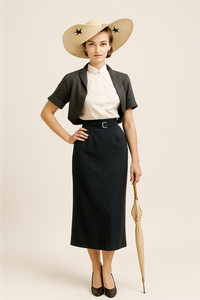
The cultural backdrop
By the early 1930s a quarter of the American workforce was unemployed, and the Great Depression had spread across Europe. Conspicuous spending — the Charleston dance, the diamond cigarette holder, the ankle-flashing flapper dress — looked tasteless. Fashion responded with two opposing impulses, both of which defined the decade.
The first was a return to traditional, elegant femininity. Hemlines dropped almost overnight; the waistline returned to where nature had put it; bodies became long and graceful again rather than boyish and angular. The second was the rise of Hollywood as a global style engine. Sound film had arrived in 1927, the studio system was at its peak, and 60–80 million Americans were going to the movies every week. What Greta Garbo, Marlene Dietrich, or Joan Crawford wore on screen on Friday was being copied in pattern catalogs and shop windows by Tuesday.
Women's fashion: the bias-cut decade
The single most important technical development of the decade was Madeleine Vionnet's perfection of the bias cut — cutting fabric on the diagonal of the weave so that it stretches and clings. A bias-cut satin gown drapes over the body like water; it required no boning, no zippers, sometimes no fastenings at all. The result was the era's signature evening look: a long, fluid column of pale silk satin that revealed the body's lines without ever fitting tightly.
Daywear
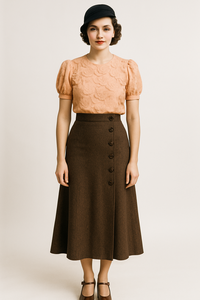
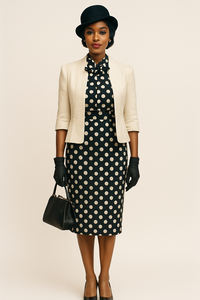
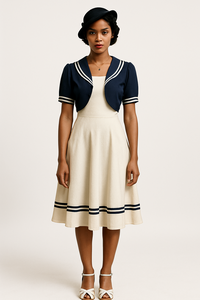
- Calf-length day dresses with defined natural waists, often with small puffed or padded shoulders
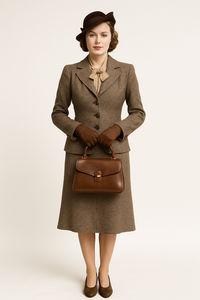
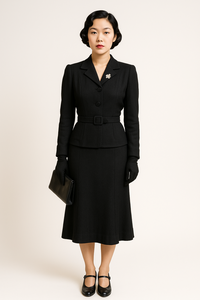
- Tailored skirt suits in wool — narrower and more sober than the loose 1920s cardigan suit
- Floral printed cottons and rayons (rayon, cheaper than silk, became the workhorse of Depression-era dressing)
- Slim belts at the waist; surplice and wrap necklines
Evening wear
- Bias-cut satin gowns in ivory, oyster, champagne, and pale pink
- Halter and cowl necklines, often deeply cut at the back rather than the front — the "backless" 1930s evening dress was a signature
- Bolero jackets and capelets to layer over slim gowns
- Long opera gloves and fur-trimmed wraps for cold weather
Men's fashion: the golden age of tailoring
For men, the 1930s are often described as the high point of 20th-century tailoring. The decade's suit was wider in the chest, narrower in the waist, with peaked lapels and a strong shoulder line — a silhouette that flattered almost every body type. Double-breasted suits, six-buttoned and worn with a pocket square, were the dominant business look in Britain and increasingly in America. Pinstripes and chalk stripes in dark navy or charcoal were the office uniform; tweed odd jackets with flannel trousers became the standard for country and weekend wear.
Two-tone "spectator" shoes (often white and brown, or black and white) defined leisurewear; Oxfords and brogues remained the office standard. The fedora was universal, but younger men adopted the trilby and the porkpie. The Duke of Windsor, formerly Edward VIII, popularized the Windsor knot, the Fair Isle sweater, and the relaxed "drape" cut tailored on Savile Row by Frederick Scholte.
Hair, makeup, and accessories
Hair grew out from the 1920s bob into a longer, softer length — usually shoulder-length, set in finger waves or pin curls and worn in a chic side parting. Platinum blonde, made famous by Jean Harlow, became the most copied hair color of the decade; bottle peroxide kits flew off drugstore shelves. Eyebrows were plucked into a thin, dramatic arch — sometimes shaved off entirely and redrawn — a look most associated with Marlene Dietrich and Joan Crawford.
Makeup became more matte and more architectural than the 1920s. Lipstick was full and dark (deep red, plum, brick); cheeks were sculpted with rouge; eyes were lined and lightly shadowed but no longer kohl-rimmed. Hats moved from the cloche to small berets, tilted toques, and wide-brimmed picture hats for spring. Costume jewelry, popularized by Chanel, made expensive-looking accessories accessible during the Depression.
Icons of the decade
- Greta Garbo — Whose androgynous tailoring, slouchy trousers, and trench coats turned menswear-for-women into a permanent option.
- Marlene Dietrich — The original woman in a tuxedo, in Morocco (1930). Her wardrobe was a manifesto.
- Jean Harlow — The platinum-blonde original; her bias-cut white satin gowns shaped how a generation imagined glamour.
- Joan Crawford — Whose padded-shoulder Adrian gowns prefigured the strong-shouldered 1940s by a full decade.
- Madeleine Vionnet — The "queen of the bias cut," whose Paris atelier defined what a 1930s evening dress looked like.
- Elsa Schiaparelli — Vionnet's stylistic opposite: a Surrealist who collaborated with Dalí, invented shocking pink, and popularized the zipper as decoration.
Gallery
How to recreate the 1930s look today
- For evening: a long bias-cut slip dress in pale satin, cut low at the back. Modern slip dresses (the kind that became popular again in the 1990s and 2020s) are direct descendants.
- For day: a calf-length midi dress with a defined natural waist, small puffed shoulders, and a small floral or polka-dot print.
- Hair: shoulder-length, set in soft waves, parted to one side. Add a small beret or tilted hat for committed authenticity.
- Makeup: thin arched brows (drawn on, not plucked off), matte ivory skin, dark red lip.
- Accessories: a marcasite or paste-jewel brooch, T-strap heeled sandals, opera-length gloves for evening, a small clutch.
Common identification mistakes
The 1930s sit between two louder decades and are often misread. The fastest tells:
- vs. 1920s: 1920s waistline is at the hips; 1930s waistline is at the natural waist. 1920s hems are at the knee; 1930s hems are at mid-calf for day, ankle/floor for evening.
- vs. 1940s: 1930s shoulders are soft and slightly puffed; 1940s shoulders are hard, square, and padded. 1930s skirts drape and flow; 1940s skirts are A-line and structured.
Upload a photo and the AI will tell you which decade it matches.