1980s Fashion: Power Suits, MTV, and Neon Excess
The 1980s did not whisper. It was a decade of shoulders the size of dinner plates, hair teased to the ceiling, neon spandex that could be seen from low orbit, and a pop culture pipeline — MTV, music videos, the gym, the corporate office — that made dressing up a daily competitive sport.

The cultural backdrop
The 1980s in the United States and Britain were politically defined by Ronald Reagan and Margaret Thatcher, both elected on a turn toward free-market economics. Wall Street boomed, the term "yuppie" entered the dictionary in 1984, and conspicuous consumption became — for the first time since the 1920s — culturally celebrated rather than apologized for. The decade was also shaped by the AIDS crisis (which began to dominate headlines from 1981), by the end of the Cold War (the Berlin Wall fell in November 1989), and by a fitness boom triggered by Jane Fonda's 1982 workout video and an exploding gym culture.
MTV launched on August 1, 1981, and within a year the music video had replaced the album cover as the primary visual delivery system for pop music. Madonna, Michael Jackson, Boy George, Cyndi Lauper, Prince, and Duran Duran taught a generation what to wear by wearing it on screen.
Women's fashion: power, fitness, and pop
Power dressing
As record numbers of women entered managerial positions, a tailored office uniform took shape that owed something to menswear and something to Joan Crawford's 1940s Adrian gowns. Giorgio Armani's relaxed Italian tailoring and Donna Karan's "Seven Easy Pieces" (1985) defined the upmarket version: oversized blazers, broad padded shoulders, knee-length pencil skirts, silk blouses with pussy bows, opaque tights, and pumps. Thierry Mugler's "monster" tailoring exaggerated the same silhouette into couture sculpture.
The leotard, the legging, and the gym
Aerobics turned exercise gear into eveningwear. Spandex and lycra arrived as everyday materials. Jane Fonda's leotards, leg warmers, headbands, and high-cut bodysuits — designed to be visible — became the off-duty uniform of millions of women who never set foot in an aerobics studio. Flashdance (1983) put the cut-off sweatshirt in every closet.
Pop and New Wave
Madonna's 1984 "Like a Virgin" wedding-meets-bondage outfit and 1985 "Material Girl" bustier-and-tulle look spawned thousands of imitators in lace gloves, layered crucifix necklaces, fingerless gloves, and ripped fishnets. Cyndi Lauper's "Girls Just Want to Have Fun" wardrobe brought thrift-store color clashing into the mainstream. Princess Diana, in another register entirely, defined a pastel romantic look — pie-crust collars, ruffles, polka dots, soft Sloane Ranger tweeds — that dominated more conservative wardrobes worldwide.
By mid-decade, neon was on every shelf: hot pink, electric blue, lime green, fluorescent orange. Acid-wash denim arrived in 1986. Stirrup pants, "banana" pleated trousers, oversized sweatshirts pulled off one shoulder (Flashdance again), miniskirts (returning after a 1970s break), bubble skirts, and ra-ra skirts cycled through the closets of the decade.
Men's fashion: the yuppie, Miami Vice, and hip-hop
The yuppie wardrobe had its own clear silhouette: a double-breasted Armani-style suit with broad padded shoulders, a power tie in a strong color (red was so common it became known as the "power tie"), suspenders, and a slicked-back hairstyle. The 1987 film Wall Street codified this look so thoroughly that it became shorthand for the decade.
Miami Vice (1984–1989) reorganized casual menswear: pastel suits in linen and cotton, T-shirts under unstructured jackets, loafers without socks, three-day stubble, slicked-back hair. This is one of the most influential American men's looks of the century. Members Only jackets, polo shirts with popped collars, parachute pants (briefly), and Nike Air Force 1s (1982) defined the casual end.
Hip-hop, born in the Bronx in the late 1970s, became a global style force in the 1980s. Run-DMC's 1986 deal with adidas — they wore the brand's tracksuits and Superstars without laces — was the first major partnership between a music act and a sportswear brand and reshaped the concept of "streetwear." Kangol bucket hats, four-finger gold rings, dookie chains, sheepskin coats, and Cazal sunglasses defined the early hip-hop wardrobe; LL Cool J's bucket hat and red leather Pumas, Salt-N-Pepa's asymmetric haircuts and bomber jackets, Public Enemy's military influences all expanded the vocabulary.
Subcultures: New Wave, Goth, and New Romantic
The early 1980s post-punk scene produced three lasting style subcultures. New Wave (Devo, Talking Heads, Blondie) was sharp, geometric, and ironic — skinny ties, asymmetric haircuts, color blocking, plastic accessories. Goth emerged from late punk (Bauhaus, Siouxsie and the Banshees, the Cure) — black everything, white pancake foundation, black eyeliner, fishnets, lace, crucifixes, backcombed hair. New Romantic (Adam Ant, Spandau Ballet, Boy George) was the dressing-up box of the three — pirate shirts, sashes, kilts, frills, eyeliner on men. London's Blitz Club birthed the look in 1979–80 and exported it through MTV.
Hair, makeup, and accessories
Volume was the only rule. Women teased, sprayed, perm'd, and crimped. The mullet — short on top and sides, long in back — was unavoidable on both men and women. The "side ponytail" tied with a giant scrunchie (introduced 1986) was schoolyard standard. Curly perms peaked mid-decade. Aqua Net and Rave hairsprays were pantry items.
Makeup matched the volume of the hair. Bright blusher swept up to the temple; multi-colored eyeshadow up to the brow (often shimmery blue or purple); thick black mascara and eyeliner; bold matte lips in pinks, reds, and corals. Madonna's 1985 black eyeliner and pencilled mole, Brooke Shields's full bushy eyebrows (a Calvin Klein revolution after years of plucking), and the heavy contour-and-blush of Dynasty all ran in parallel.
Accessories: large statement earrings (often plastic geometric shapes), digital watches, Swatch watches (introduced 1983 and instantly collectible), jelly bracelets, fingerless gloves, headbands, leg warmers, and the now-iconic 1980s plastic sunglasses (Wayfarers had a huge revival after Tom Cruise wore them in Risky Business, 1983).
Icons of the decade
- Madonna — Whose constantly mutating image (Boy Toy, Material Girl, Like a Prayer) became fashion's central engine.
- Princess Diana — Pussy-bow blouses, cycling shorts under a sweatshirt, the "revenge dress" of the next decade. The world's most photographed woman.
- Michael Jackson — Red leather jacket from Thriller, single sequined glove, white socks with black loafers — each instantly iconic.
- Grace Jones — Whose Antonio Lopez and Jean-Paul Goude collaborations defined a sharp, geometric, androgynous beauty standard.
- Boy George — Eye makeup, braided hair extensions, romantic blouses; Culture Club's frontman pulled the New Romantic look into the mainstream.
- Giorgio Armani, Donna Karan, Thierry Mugler, Jean Paul Gaultier — The four designers whose work most defined high-1980s tailoring.
- Run-DMC — Whose adidas partnership built the foundation of modern streetwear.
Gallery
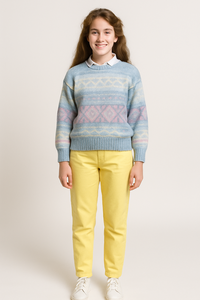


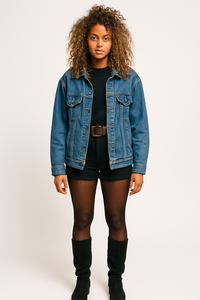
How to recreate the 1980s look today
- Power dressing: an oversized blazer (genuinely oversized, not slightly), a knee-length pencil skirt or high-waisted tapered trousers, a silk blouse with a pussy bow, opaque tights, pumps, big earrings, slicked or volumized hair.
- Aerobics/Madonna: a leotard or bodysuit under a layered miniskirt or cycling shorts, leg warmers, scrunched socks, layered necklaces, lace fingerless gloves, a big bow in the hair.
- Miami Vice: a pastel unstructured linen blazer over a white T-shirt, pleated trousers, loafers without socks, aviator sunglasses, three-day stubble.
- Hip-hop golden era: an adidas tracksuit, Superstars worn with the laces out, a Kangol bucket hat, a thick gold chain, a four-finger ring.
- Hair: volume, volume, volume. A side ponytail with a scrunchie, or a heavily teased crown, or a permed perimeter.
Common identification mistakes
- vs. late 1970s: shoulder pads existed in the late 1970s but were soft. Once shoulders are visibly, geometrically square — read: a clear horizontal line at the top of the jacket — you are firmly in the 1980s.
- vs. early 1990s: the look bleeds into the early 1990s. Once the silhouette starts to drop and slouch (oversized but not padded), the era is 1990s.
Upload a photo and the AI will tell you which decade it matches.