1990s Fashion: Grunge, Minimalism, and the Supermodel Era
After a decade of shouting, fashion in the 1990s learned to whisper. Hemlines, hairstyles, makeup, and shoulder pads all came back to earth. The decade produced two opposing wardrobes — flannel-and-Doc-Marten grunge from Seattle and slip-dress minimalism from Calvin Klein — that have never stopped influencing what people wear.
The cultural backdrop
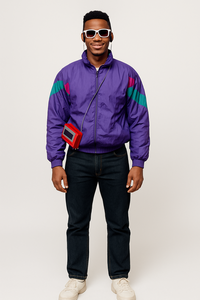
The 1990s opened with the fall of the Berlin Wall (still warm from late 1989), the collapse of the Soviet Union (1991), the first Gulf War (1990–91), and an economic recession in the West. Mid-decade brought the dot-com boom, the rise of the World Wide Web (the first browser, Mosaic, dropped in 1993), and the cultural ascendance of indie music, independent film, and ironic detachment as a mood. Generation X coined the word "slacker."
Two genres of music drove the decade's two main aesthetics. Seattle grunge — Nirvana's Nevermind arrived in September 1991 — turned secondhand thrift-store clothing into a uniform. Hip-hop, already a force in the late 1980s, became the dominant pop genre of the decade and built its own multi-billion-dollar fashion industry. Meanwhile, on the runway, a quiet luxury revolution led by Calvin Klein, Helmut Lang, Jil Sander, and Prada redefined what high fashion could look like — much, much less than before.
Women's fashion: three (or four) decades in one
Grunge (1991–1994)
The Pacific Northwest indie-rock scene's wardrobe — flannel shirts (often plaid, often men's), oversized cardigans, ripped jeans, slip dresses worn over T-shirts, Doc Martens, Converse, beanies, knit caps — was photographed onto the runway by Marc Jacobs in his famous (and famously fired-from-Perry-Ellis) Spring 1993 collection. Courtney Love's "kinderwhore" version — torn babydoll dresses, ripped tights, smudged red lipstick, bleached hair with dark roots — became one of the era's most copied looks. The defining model was a 19-year-old Kate Moss in a baby tee and slip skirt.
Minimalism (1993–1999)
Calvin Klein's late-1990s campaigns and his use of Kate Moss as house muse made minimalism the era's high-luxury default. The wardrobe: a thin spaghetti-strap slip dress in plain ivory, gray, or black satin; a plain white tank; black wide-leg trousers; a black turtleneck; a long pencil-line wool coat; pointy-toe black mules. No prints. No embellishment. No logos. Helmut Lang and Jil Sander pushed the look further into austerity. Prada's nylon-everything (especially the small black backpack of 1985 that became ubiquitous in 1994) was the same impulse in a different texture. The Row would later turn this 1990s sensibility into a permanent luxury category.
Hip-hop and streetwear
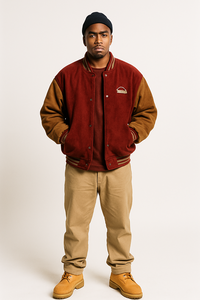
Tommy Hilfiger logos, Polo Sport, Nautica, Sean John (1998), FUBU (1992), and Karl Kani built a hip-hop ready-to-wear industry. Baggy jeans (sized often four to six inches above the natural waist), oversized basketball jerseys, Timberland boots, hoodies, gold chains, and bandannas defined the male wardrobe. Aaliyah's tomboy combination of baggy jeans, crop tops, and bandeau tops, and TLC's matching baggy oversized sets, defined the female version. By the late 1990s the look had crossed over into mainstream pop (the Spice Girls, Britney Spears, Destiny's Child).
Late 1990s preview of Y2K
By 1998–99 a new mood was forming: shiny, futuristic, baby-pink, optimistic. Plastic everything. Halter tops. Tiny purses. Butterfly clips. Frosted lipstick. Hello Kitty. This is the bridge into the 2000s and is sometimes called the "futuristic" or "millennial" mini-era.
Men's fashion: from oversized to hip-hop to indie
The 1980s power suit's shoulders softened and dropped. Suits became single-breasted, longer in the jacket, with slimmer (but not yet skinny) lapels. Brown and khaki suits replaced the Wall Street navy. The "soft Italian" school — Armani, but now also Prada — made the dominant high-end menswear silhouette of the decade.
Casual menswear belonged to either grunge or hip-hop. The grunge male wardrobe was direct: flannel shirt over a band T-shirt, ripped Levi's 501s, Converse Chuck Taylors or Doc Martens, a beanie, long unwashed hair. The hip-hop male wardrobe was its mirror image: spotless oversized white tees, baggy jeans worn low, fresh Air Jordans (the Air Jordan III in 1988 made sneaker culture mainstream), gold chains, sometimes a do-rag.
By the late 1990s the British "indie sleaze" precursor was emerging — Britpop bands (Oasis, Blur, Pulp) wearing parka jackets, Adidas Gazelles or Sambas, mod-revival button-downs, and skinny black jeans — a look that would explode again in the early 2000s.
The supermodel era
The 1990s is the decade of the supermodel. Linda Evangelista, Christy Turlington, Naomi Campbell, Cindy Crawford, Claudia Schiffer, and Tatjana Patitz appeared together on the January 1990 British Vogue cover photographed by Peter Lindbergh and recorded George Michael's "Freedom! '90" video in November 1990. Evangelista's "we don't wake up for less than $10,000 a day" quote, given to Vogue in October 1990, captured a moment when models were more famous than the actresses they were dressing. The look they collectively defined — long glossy hair, glowing skin, "no-makeup" makeup, a slim body in a slip dress and a tailored coat — became the era's beauty standard.
The 1993 arrival of an extremely young, extremely thin Kate Moss in Calvin Klein's "heroin chic" campaigns (photographed by Corinne Day) ended the supermodel era and started a new one in the same magazine spreads.
Hair, makeup, and accessories
Hair came down. The Rachel — Jennifer Aniston's layered, framed-around-the-face cut on Friends from 1994 onward — was the most-requested haircut of the decade. Center-parted long hair (Cindy Crawford), the bob (Linda Evangelista's 1988 Sassoon cut still echoing), pixie cuts (Winona Ryder), and frosted highlights all coexisted. Hip-hop hairstyles — high-top fades, finger waves, crimped, micro-braided — drove a parallel mainstream. Butterfly clips and tiny pigtails defined late-decade pop styling.
Makeup became matte and brown. Kevyn Aucoin and Bobbi Brown popularized neutral, "your skin but better" looks: nude or brown lipstick, light bronzer, brown shadow, a lined lower lash line. Goth and grunge girls layered black eyeliner with purple-brown lipsticks (Heather, Crushed Berry). Frosted body shimmer arrived around 1998.
Accessories: the small backpack handbag (Prada, 1994), the Fendi Baguette (1997), the small pashmina shawl (1998), tinted micro sunglasses, hemp-cord chokers, hemp-cord bracelets, plastic chokers, scrunchies (still hanging on from the 1980s), Timberland boots, Doc Martens, jelly sandals, and white Reebok Classics.
Icons of the decade
- Kate Moss — Whose 1993 Calvin Klein campaign ended the supermodel era and started "heroin chic."
- Jennifer Aniston — The Rachel cut, the white tank top, the slip dress, and a permanent template for "off-duty" American style.
- Tupac Shakur and Aaliyah — Two of hip-hop's most influential 1990s style figures.
- Princess Diana — Whose 1994 "revenge dress" (a black off-shoulder mini Christina Stambolian) was the most-photographed dress of the decade.
- Gwen Stefani — No Doubt; bindi, crop top, white belly, and a generation of teenage girls.
- Calvin Klein, Helmut Lang, Jil Sander, Prada, Marc Jacobs — The five designers most defining 1990s fashion at the high end.
- Carolyn Bessette-Kennedy — Whose minimalist personal style (slip dresses, sleek hair, ivory satin Yohji Yamamoto wedding dress) became a permanent reference.
Gallery


How to recreate the 1990s look today
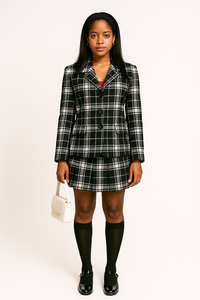
- Grunge: a thin floral slip dress under an oversized plaid flannel shirt, black opaque tights, lace-up Doc Martens, a beanie, smudged dark eyeliner, dark red lipstick.
- Minimalist: a plain ivory satin slip dress, no jewelry, hair brushed flat in a center part, pointed black mules, a long line wool coat, nude or brown matte lip.
- Hip-hop: baggy high-waisted jeans, a fitted crop top or oversized jersey, Timberlands or Air Jordans, hoop earrings, a bandanna headband.
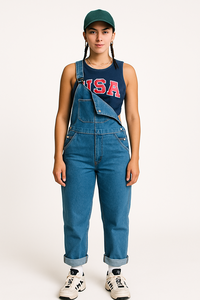
- Casual everyday: a high-waisted mom jean, a fitted ribbed tank, a denim jacket, Reebok Classics or Adidas Sambas, a small Prada-style nylon backpack.
Common identification mistakes
- vs. late 1980s: if shoulders are padded and square, it's 1980s. The same oversized blazer with a soft, dropped shoulder is 1990s.
- vs. early 2000s: the late-1990s shiny, futuristic, low-rise mini-trend is functionally identical to early Y2K. Logos (especially Juicy Couture, Von Dutch) and ultra-low-rise jeans push an outfit into 2000s territory.
Upload a photo and the AI will tell you which decade it matches.